

• Chattanooga Hot Springs is a primitive hot spring at the Middle Fork of the Boise River
Chattanooga Hot Springs is a remote backcountry hot spring in rural Idaho, tucked into the Boise National Forest about a mile and a half from the historic mining town of Atlanta. This natural geothermal pool draws visitors seeking a quiet soak in hot mineral water, with beautiful views of the Sawtooth Wilderness Area and the Middle Fork of the Boise River.
The hot springs are availale year-round, but because the area lies deep in the forest at a higher elevation, the ideal time to visit Chattanooga Hot Springs is from late June through September, when roads are generally dry and snow-free.
Middle Fork Boise Road, the main access route, is not plowed in winter and is typically closed or impassable from November through May due to heavy snow, ice, and avalanche risk. Once winter sets in (usually by late October), Atlanta and nearby hot springs can only be reached by snowmobile, snowcat, or on skis or snowshoes, recommended only for experienced backcountry travelers who are familiar with winter and avalanche conditions.
The steep cliff trail drops about 100 feet from the parking area to the pool and can be loose or slippery, especially after rain or in early spring.
👉 Know Before You Go:
- There are no gas stations nearby, so fill up before heading in.
- Cell service is limited around Atlanta and along the Middle Fork Boise River.
- Emergency services are not readily available.
- Roads are rough, unpaved, and prone to washouts, so high-clearance 4WD is strongly recommended.
Atlanta Hot Springs Geothermal Experience
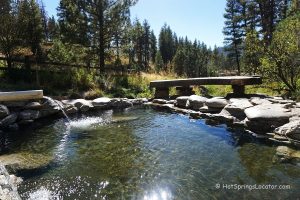
Chattanooga Hot Springs is one of the several natural hot springs emerging along the Middle Fork of the Boise River. It features a single, fairly big soaking pool built by volunteers at the base of a steep cliff.
Hot mineral water flows out of the cliff at about 120°F and runs roughly 100 feet down into a rock-and-sand pool. By the time it reaches the pool, the water usually cools to around 100–110°F, which is ideal for geothermal soaking.
Season and river conditions permitting, visitors can move around within the pool to find warmer or cooler spots to soak at the temperature they prefer.
Chattanooga Hot Springs is a primitive, undeveloped soaking area with no services or facilities. There are no restrooms, trash cans, or potable water. Pack out everything you bring in and practice Leave No Trace principles.
Clothing is optional at the springs. Because the soaking pool is relatively exposed from portions of the trail, visitors should be aware that they may encounter both clothed and unclothed bathers.
Power Plant Recreation Area and Atlanta Hot Springs are nearby.
Things to Do near Chattanooga Hot Springs: Beyond Hot Springs
Beyond soaking in Chattanooga Hot Springs, the Atlanta area offers a wide range of outdoor activities.
You can explore the old mining town of Atlanta, Idaho, with its mining relics, historic cabins, and an 1860s schoolhouse that reflects the region’s Gold Rush history.
Trails like Graylock Mountain, Buck Creek, and Powerplant lead through forests and along the Middle Fork of the Boise River, offering scenic viewpoints and great opportunities for wildlife photography.
The river and nearby creeks are excellent for trout and whitefish fishing. While you are here, you may also see elk, deer, eagles, and other wildlife in the surrounding hills and valleys.
Mountain bikers will find challenging forest roads and trails with big climbs and sweeping views of the Sawtooth landscape.
Photographers can capture steaming hot springs, historic structures, and dramatic mountain backdrops.
In winter, when conditions allow and with proper gear, the Atlanta area becomes a snowmobiling and cross-country skiing destination for experienced backcountry adventurers.
Chattanooga Hot Springs Camping and Lodging
There is no campground or lodging directly at Chattanooga Hot Springs, but camping and lodging options are available nearby in the same general area as other Middle Fork Boise River hot springs.
Power Plant Campground (managed by Boise National Forest) has 24 sites with fire rings, grills, picnic tables, a horseshoe pit, and a vault restroom. The campground is typically open from May to September on a first-come, first-served basis and does not offer running water or electrical hookups, so visitors should bring all necessary supplies.
Riverside Campground sits along the Middle Fork of the Boise River, about 2 miles from the Power Plant area, and offers scenic river views, picnic tables, fire pits, and easy access for fishing. You can make reservations through Recreation.gov during the main season from mid-June to the end of September. Outside this period, sites are first-come, first-served. Like Power Plant Campground, there are no hookups or potable water.
Dispersed camping in Boise National Forest is also possible in some pullouts and side roads near Atlanta and along Middle Fork Boise Road, where allowed. Always follow posted regulations, observe fire restrictions, and camp on durable surfaces.
Chattanooga Hot Springs | Facts
Location: 130 miles east of Boise • Central Idaho • USA
Best time: Late June to early October
Development: Wild
Clothing: Optional
Amenities: None
Hiking distance: 100 feet
Road Access: A 4WD high clearance vehicle
Day-use fees: None
Managed by: U.S. Forest Service
Elevation: 5,300 ft (1,615 m)
Water T° (source): 120°F (49°C)
Water T° (pool): 100-110°F (38-43°C)
More Adventures




Directions to Chattanooga Hot Springs
Atlanta can be accessed via unpaved forest roads only. With this in mind, a 4WD high clearance vehicle is recommended to navigate the area. Some roads are closed during the winter months. Check directions here.
From Atlanta,
- Follow 1.2 miles east on Main Street/Middle Fork Boise River Road
- Just before the Frog Pond at Atlanta Hot Springs turn left and go 0.2 miles to the end of the road.